Impco LPG carburetion theory and operation
Return to Automotive LPG Fuel 
Carburetor. IMPCO carburetors are an air-valve design,
using a relatively constant low pressure drop to draw fuel into
the carburetor from cranking to full load. The advantage of this
type of construction is a strong "signal" or vacuum set up by a
metering spring (A) holding the air valve (B)
closed. A pressure drop (C) under the air valve of
approximately 6" WC (Water Column) is required to open the valve
during cranking. Vacuum to the converter (D) and filter/fuelock
(D) allow fuel to flow. When the engine is stopped, fuel
is safely sealed off within the carburetor, converter and fuellock.
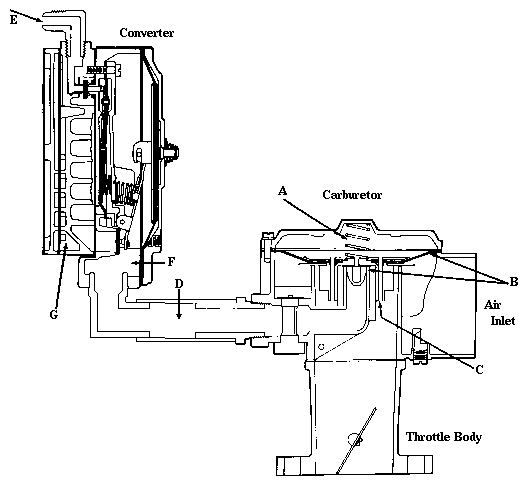
The air-fuel metering upper part of the carburetor, called a mixer,
is completely self-contained. It derives it's vacuum feedback signal
from the throttle bore.
Converter. The IMPCO converter is a combined two-stage
regulator and vaporizer. It receives liquid fuel at tank pressure
(approximately 180PSI) from the filter/fuelock (E) and
reduces pressure in two stages to slightly less than atmospheric
(F). When the engine is cranking or running, a partial
vacuum is created in the vapor line to the carburetor (D),
which opens the regulator permitting fuel to flow to the carburetor.
In the process of reducing the pressure in the tank to atmospheric,
the liquid propane expands to become a vapor, absorbing heat in the
process. Water from the engine cooling system circulates through
a heat exchanger (G) to avoid freezeup. The regulator
seals off fuel flow when the engine is stopped (H).
IMPCO makes three sizes of converter, the Model J which is rated
at 100HP maximum, and the Model L and Model E which are rated at
325 HP maximum.
Fuelock/Filter. The filter/fuelock (Model VFF30) is vacuum
operated. Upon slight engine vacuum (2" WC), it opens and allows
fuel from the tank to flow through a fuel filter, to the converter.
Any time the engine stops, whether the ignition key is on or off,
the fuel is shut off automatically. It also filters any large
particles of solid material out of the fuel before they reach the
high-pressure side of the converter.
Return to Automotive LPG Fuel